



Physical AI and Autonomous Mobile Robots: Bringing Intelligence into Motion
Artificial intelligence is moving beyond screens and software into the physical world. From robots transporting materials in factories to machines inspecting equipment, Physical AI enables systems to perceive their surroundings and respond to changing conditions.
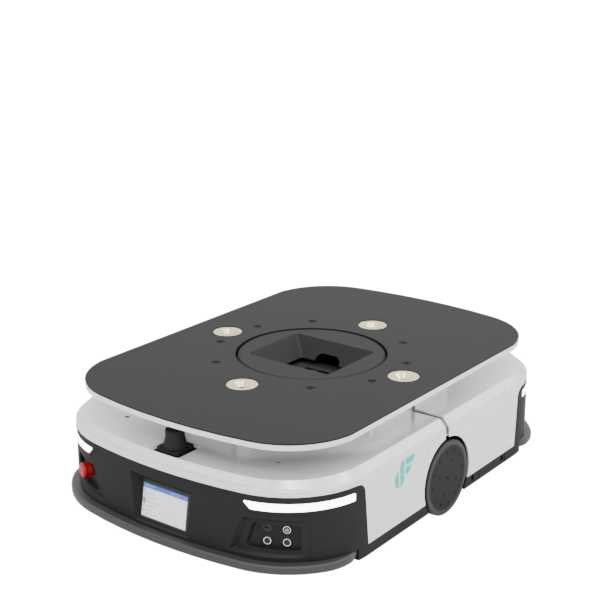
One application of this technology is the Autonomous Mobile Robot (AMR). By combining mobility, sensors and intelligent decision-making, AMRs help businesses automate material movement in environments where people, equipment and production needs are constantly changing.
What Is Physical AI?
Physical AI refers to AI systems that can perceive, reason about and act within the physical world. It brings intelligence from digital software into physical machines, enabling them to interact with their surroundings. Traditional automation often follows fixed instructions or operates within a controlled environment. Physical AI systems use sensor data and intelligent decision-making to respond to changes in real time.

A major focus of advanced Physical AI research is semantic understanding and reasoning, which helps robots interpret instructions, recognise objects and understand their context. Vision-language-action (VLA) models combine visual observations, language instructions and the robot’s current state to generate appropriate physical actions. Research into world models extends this capability by helping robots predict how their actions could change the environment and plan accordingly.
An AMR, for example, can detect an obstacle and respond by stopping or finding an alternative route [click here to watch]. More advanced systems may also interpret task instructions and use contextual information to guide their actions. These capabilities vary between systems; not every AMR uses VLA or world models.
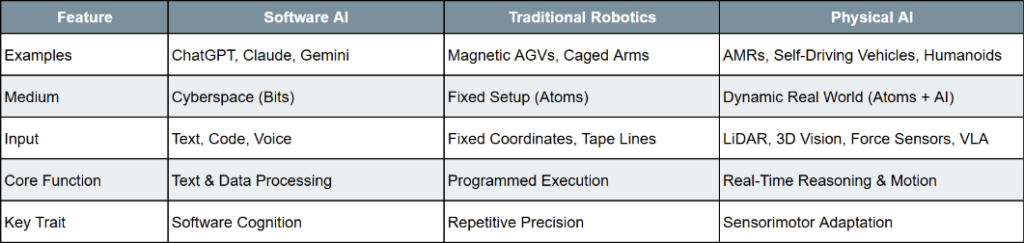
Here is a comparison of software AI, traditional robotics and Physical AI to illustrate how they differ in their operating environments, inputs and capabilities.
Table 1: Comparison of software AI, traditional robotics and Physical AI.
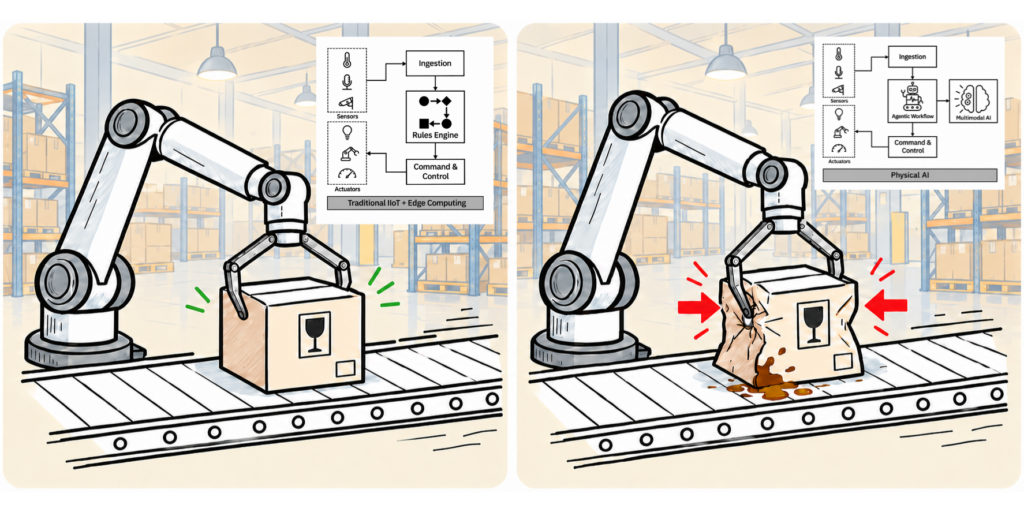
For AMRs, this means using information from their surroundings to guide movement and respond to obstacles while completing transportation tasks.
Video 1: Traditional robotic movement
Video 2: Robot movement with Physical AI approach
How Does Physical AI Work?
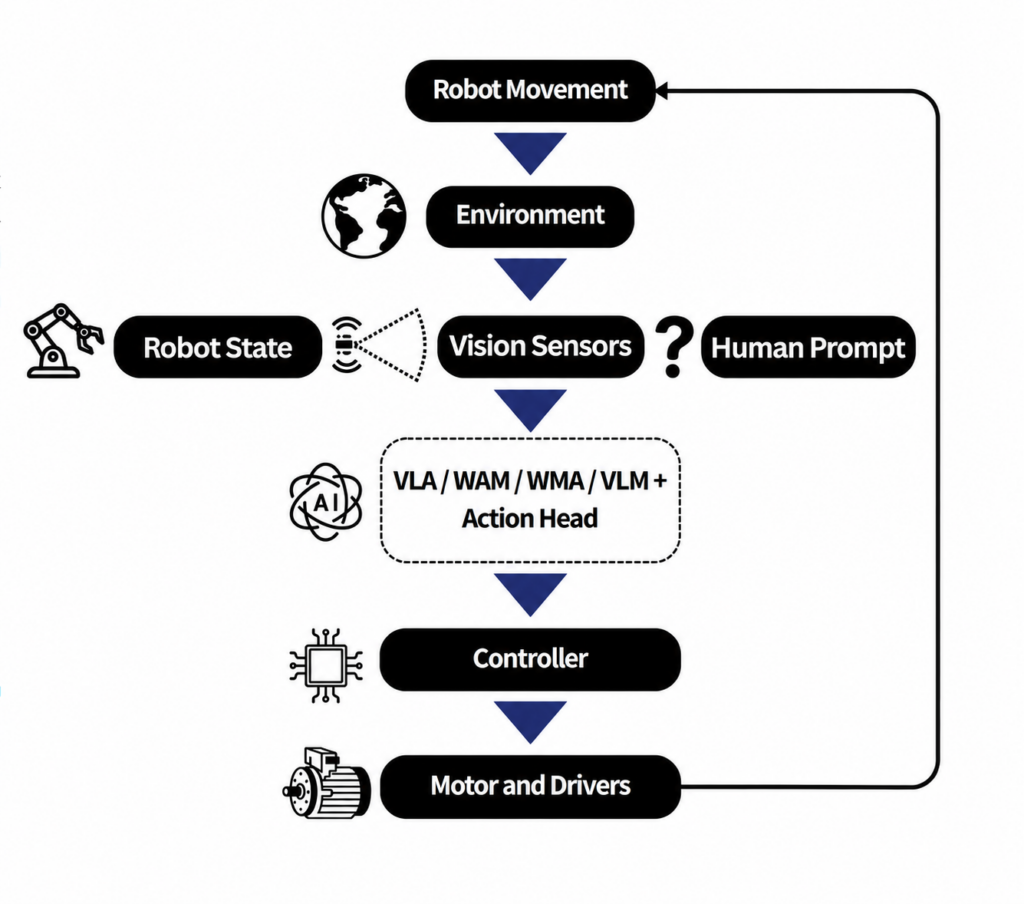
Physical AI operates through a cycle of sensing, deciding, acting and learning, allowing machines to interact with and respond to their surroundings.
- Sense: Sensors such as LiDAR and cameras collect information about the environment, including nearby objects and obstacles.
- Decide: The system processes this information to determine its location and select an appropriate action based on its task and surroundings.
- Act: The robot carries out the action, such as moving along a route, stopping or changing direction.
- Learn: Some Physical AI systems use operational data and feedback to improve their performance over time. Depending on the system, learning may take place through training and updates rather than during operation.
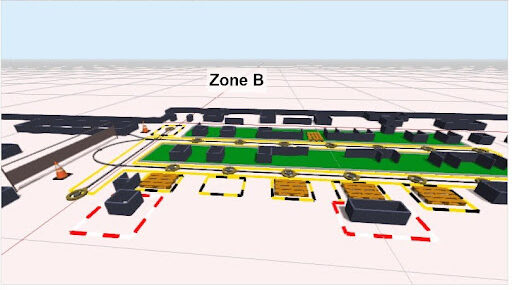
For an AMR, this process supports autonomous navigation through a factory or warehouse. Using technologies such as LiDAR-based simultaneous localisation and mapping (SLAM), the robot can build a map of its surroundings and use it to navigate without relying on magnetic tape or floor wires.
Do AMRs and AGVs Require VLA Systems?
Not required today
Most AMRs carry out predefined tasks within mapped facilities. While people, equipment and obstacles may change, the task itself remains clearly defined and typically does not require the robot to interpret meaning or context.
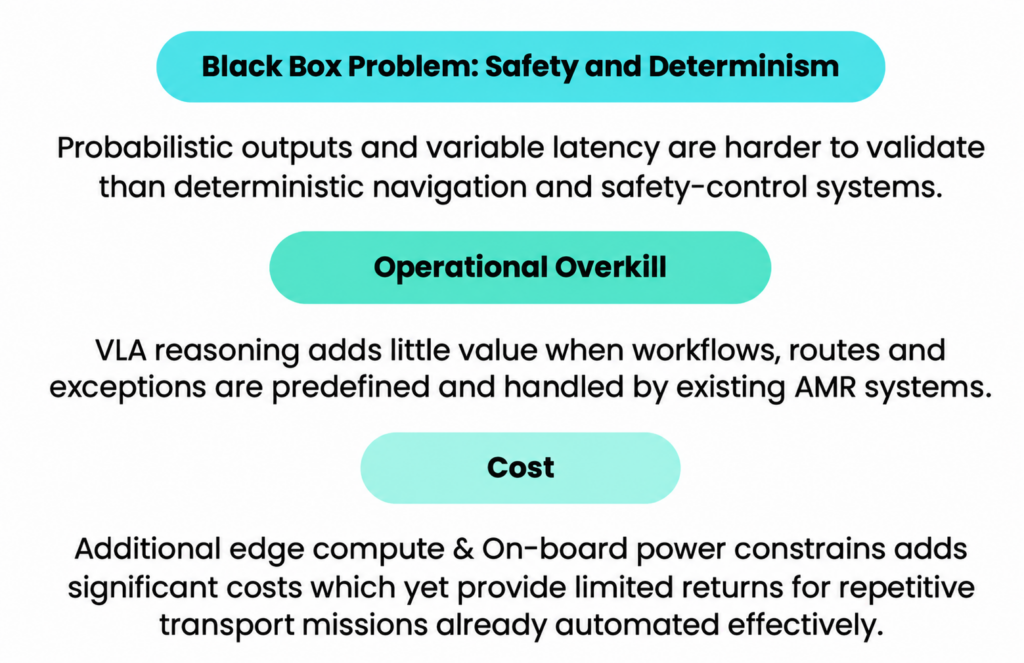
But maybe in the future?
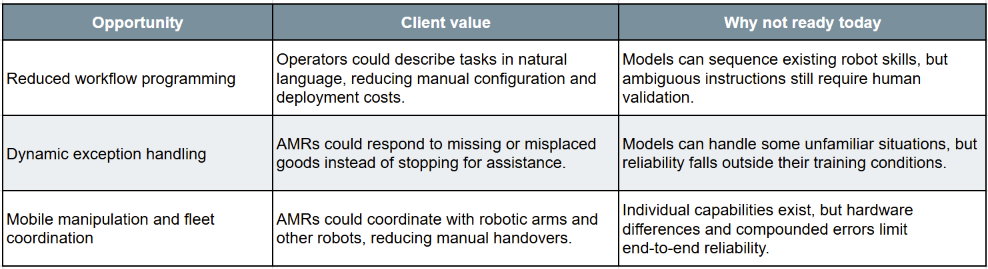
For more complex applications, VLA models could help mobile robots interpret instructions and connect their observations with appropriate actions. Potential opportunities includes as in the table 2.
Table 2: Potential Benefits and Challenges of VLA Adoption in Mobile Robots
Where Are We Today?
Today’s disclosed VLAs are generally comparable in size to compact 2023–2024 LLMs
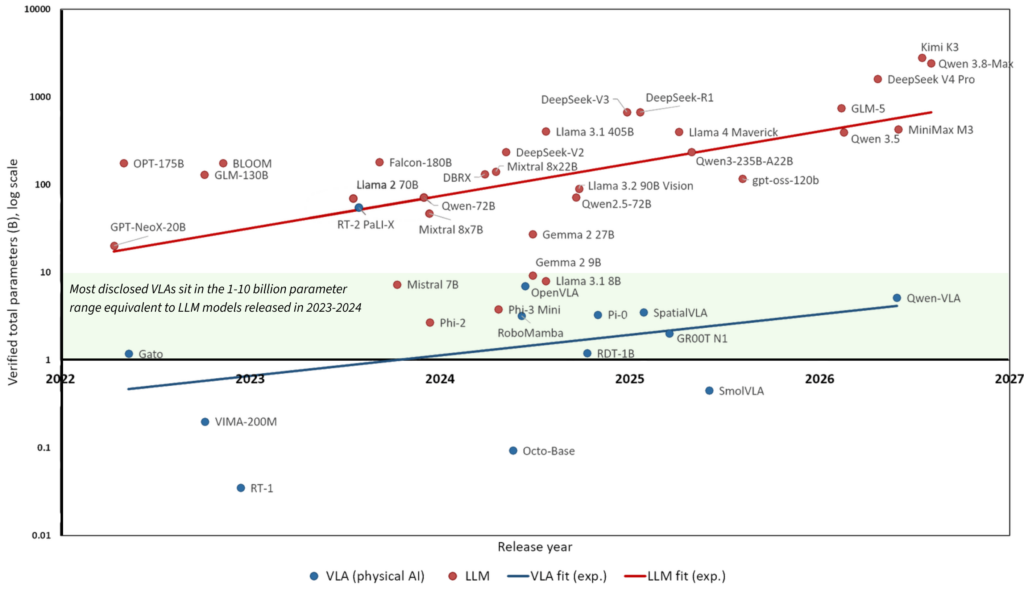
Diagram 1: Verified total parameter count of selected disclosed VLA and open-weight LLMs by release year (Source: Vynn Capital)
Model Scale Gap Reflects an Earlier Scaling Cycle for VLAs
A substantial scale gap persists
Kimi K3 has 2.8 trillion total parameters, while the largest VLA shown, RT-2 PaLI-X, has 55 billion—approximately 51 times fewer. Most VLAs remain below 10 billion.
Parameter scale does not equal performance for physical AI
Larger models may improve reasoning, but real-world performance depends more on data quality, embodiment, latency and control reliability.
Key Approaches and Supporting Technologies for Physical AI in Robotics
Table 3: Key AI Models and approaches in Robotics
| Approach / technology | How it works? | Example in an AMR or robot |
| Vision-Language-Action (VLA) | Combines visual observations and language instructions to generate robot actions. | An appropriately trained robot responds to “Move beside the blue trolley” by interpreting the scene and generating movement actions. |
| AI perception with conventional planning and control | AI interprets the surroundings, while separate planning and control software manages movement. | An AMR recognises a pallet and plans a route around it. |
| Vision-Language Models (VLMs) with robot tools | Interprets images and instructions, then calls existing robot functions rather than directly generating motor actions. | Converts “Go to the empty loading bay” into a destination for the navigation system. |
| SLAM and AI-enhanced SLAM | Builds a map while estimating the robot’s position. AI-enhanced versions add learned features or semantic understanding. | An AMR maps a factory and locates itself within it. |
| Imitation learning / learning from demonstration | Learns behaviour from demonstrations provided by people or other controllers. | Learns docking movements from recorded examples. |
| Reinforcement learning (RL) | Learns through trial and error using rewards and penalties, often in simulation. | Learns how to manoeuvre through a narrow space. |
| World models and model-based learning | Learns to predict the effects of possible actions to support planning. | Predicts how nearby objects may move before selecting an action. |
| Visuomotor policies without language | Maps visual observations to actions without requiring language input. | A robot arm uses camera images to align with and pick up a component. |
Real-World Use Cases
Physical AI is already being applied across industries to support tasks that require machines to interact with the real world.
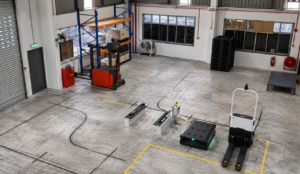
1. Autonomous Mobile Robots
AMRs transport materials, components and finished goods between locations in factories and warehouses. They can navigate changing environments, respond to obstacles and support the timely movement of materials between production processes.
In automotive manufacturing, for example, AMRs can deliver components to line-side stations in the body shop and assembly areas. This reduces the need for operators to spend time travelling to collect materials and supports a more coordinated delivery process.
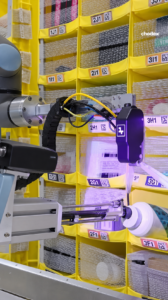
2. AI-Powered Picking and Packing
Robotic picking systems use vision and AI to identify items and support picking and packing operations. Advanced systems can adjust their movements or grip to handle products with different shapes, sizes and characteristics. (Source: Amazon)
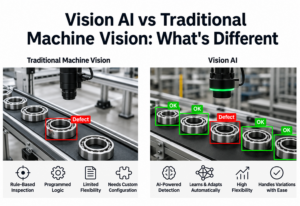
3. Vision-Guided Quality Inspection
AI-powered vision systems inspect products and components for defects during production. By analysing images in real time, they can help identify issues early and support consistent quality checks. (Source: iFactory AI)
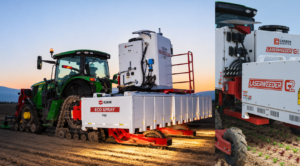
4. Autonomous Agricultural Machinery
Autonomous agricultural machines can identify and respond to conditions in the field. For example, precision weeding systems can target individual weeds, helping reduce the need for blanket chemical application. (Source: Carbon Robotics)
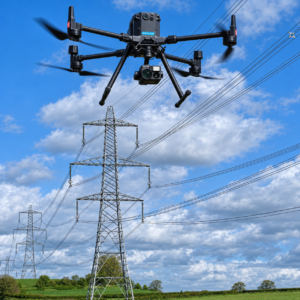
5. Industrial Inspection Drones
Inspection drones equipped with cameras and other sensors can examine structures and equipment in locations that may be difficult or hazardous for people to access. They can support inspections of areas such as power lines and industrial facilities. (Source: INSPENET)
Business & Operational Benefits
1. Operational Agility & Resilience
AMRs can adapt to unexpected obstacles and layout changes without relying on magnetic tape or fixed floor guidance. Routes can be updated digitally, helping businesses expand material delivery operations with minimal disruption.
2. Maximum Efficiency & Output
AMRs support continuous productivity by automating repetitive material transportation and reducing delivery bottlenecks. Fleet management systems coordinate multiple robots, balancing workloads, managing traffic and scheduling battery charging to maintain efficient operations.
3. Safety & Workforce Value
Physical AI systems can reduce workers’ exposure to demanding or hazardous tasks, such as heavy material handling and transportation through busy areas. With appropriate safety measures and risk assessments, AMRs can operate alongside employees, allowing them to focus on tasks that require human skills and judgement.
Barriers of Adoption
Barriers vary depending on the application. The following challenges are particularly relevant to advanced learning-based Physical AI systems, including those using VLA models.
1. Safety and Predictability
Physical AI systems operate in the real world, where unexpected situations can occur. Some advanced AI models can make decisions that are difficult to explain, making failures harder to diagnose and safety performance more challenging to validate.
2. Costly Physical Data Collection
Training advanced robotic systems can require data from real robot operations. Collecting this data involves operating and calibrating robots, supervising tasks, resetting equipment and checking data quality—all of which take time and resources.
3. Limited Robot Action Data
Data available on the internet can provide information about objects and environments, but it does not necessarily include the robot movements, states and control commands needed to perform physical tasks.
4. Difficulty Transferring Between Robots
Robots differ in their sensors, physical designs and control systems. As a result, data or models developed for one robot may not transfer easily to another. This can make it more difficult to scale advanced AI systems across different robots, tasks and sites.
Physical AI is bringing intelligence into machines that can sense, move and act in the real world. AMRs demonstrate this in factories and warehouses by navigating changing environments and automating material transportation.
The value of Physical AI lies in how effectively it solves operational challenges. For businesses considering adoption, the focus should be on the application, safety, integration and measurable outcomes, not simply whether a solution carries an AI label.
Reference
- Vynn Capital – https://vynncapital.com/publication/physical-ai-and-its-role-in-robotics-by-df-automation-and-vynn-capital/
- Google DeepMind – https://deepmind.google/blog/rt-2-new-model-translates-vision-and-language-into-action/
- NVIDIA GitHub – https://github.com/NVIDIA-ISAAC-ROS/isaac_ros_nvblox
- Google DeepMind – https://deepmind.google/models/gemini-robotics/embodied-reasoning/
- ETH Zurich – https://up-drive.ethz.ch/past-present-and-future-of-simultaneous-localization-and-mapping-towards-the-robust-perception-age/
- Columbia University – https://diffusion-policy.cs.columbia.edu/
- arXiv – https://arxiv.org/abs/1812.03201
- Nature – https://www.nature.com/articles/s41586-025-08744-2
- Google Research – https://sites.research.google/palm-saycan
Authors: Dr Yeong Che Fai
Editor: Shalani Krishnan
DF Automation & Robotics is one of the leading robotics companies in Southeast Asia, specializing in the design and manufacture of Autonomous Mobile Robots (AMRs) for the global automation and robotics industry. The company’s success is driven by its two proprietary AMR software solutions – NavWiz and DFleet – which are utilized across multiple industries. NavWiz serves as the cognitive engine for the robots, enabling seamless autonomous navigation, while DFleet facilitates efficient fleet management and optimizes traffic control in factory environments.
With over 500 robots deployed worldwide, DF Automation & Robotics has successfully expanded its solutions to countries such as Malaysia, Singapore, Thailand, India, Mexico, and various European nations. Visit www.dfautomation.com to learn more.