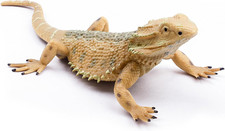



1935 the TUATARA magazine article, New Zealand Reptile lizard Sphenodon Hatteria
Check the listing for details.


| Location | Hubbards, Nova Scotia CA |
| Shipping | USD 1.87 · Flat |
| Seller |
busybeas_books
100% positive · 15865 feedback
|
| Listing | FixedPriceItem · Active |
| Start time | 2020-01-26T11:22:30.000Z |
| End time | 2023-12-26T11:22:30.000Z |
| Time left | P6DT48M42S |
| Restocking Fee | No |
| Return shipping will be paid by | Seller |
| Returns Accepted | Returns Accepted |
| Item must be returned within | 30 Days |
| Country/Region of Manufacture | United States |
| Type | magazine article |
| Reptile Species | Lizard |
Selling is a 1935 magazine article about: The TUATARA Title: TUATARA Author: Frieda Cobb Blanchard, Ph.D. Subtitled "Living Fossils" Walk on Well-Nigh Inaccessible Rocky Islands off the Coast of New Zealand” Quoting the first page “What is this Sphenodon that you are so anxious to see in its own home?" I asked my biologist husband as we steamed along in mid-Pacific. "Oh, it's a lizard-shaped reptile with some very primitive characters," he replied. "It lives only on the rocky islands off the coast of New Zealand." Back flashed my thoughts to the zoology lecture room in Cambridge, Massachusetts, where I had learned my comparative anatomy of vertebrates-back to the imaginings of a few moments that had stayed with me through the years since. Living reptiles, our professor had told us, are put into four orders: first, the alligators and crocodiles; second, the turtles and tortoises; third, the snakes and lizards; and fourth-with an order all to itself-Hatteria, a "living fossil," a primitive reptile belonging to the past but actually crawling about, now, on "inaccessible, rocky islands off the coast of New Zealand." The isolation of poor Hatteria had caught my imagination. New Zealand was about as far from Boston as it could be! A "living fossil" was remote again, separated by ages from its own kind, all long since extinct! It became for me in that moment a symbol of isolation and loneliness, to haunt my memory. And now, looking out over the dazzling blue ocean, I could hardly believe my ears. "You can't mean Hatteria?" I hardly dared ask. "Yes, that's a name sometimes used." The native Maoris call it by still a third name, "tuatara." The whole trip changed for me in an instant. I truly realized now that I was faring to see wonders. We were actually expecting to find my old friend Hatteria, also known as Sphenodon and tuatara. As I visualized those rocky islands, steep, rough with barnacles where the waves beat in, or slippery with seaweed, I looked at the tiny three-months-old baby in the folding "pram" between us. What about her? There was no way of leaving her out of the scramble; she must go where we went. I, for my part, did not intend to be left out! I will sling her to my shoulder, I decided-and perhaps she will enjoy it, too. Chilled by the cold wind blowing straight in from the South Polar regions, we came in at length to "windy Wellington." Asking to see the "tuatara" in his natural condition seemed to us a very modest request. But it was not. Sight-seeing, we found, is managed for you, and is very simply and easily done-if you want to see the sights that should be seen. But if you happen to be a biologist, and want, as we always did, to see some outlandish thing, or to go to some place that is not on exhibition instead of to the conventional sights, there are many difficulties. Arranging to see the tuatara might have been difficult for us were not New Zealanders the most friendly, hospitable, and helpful people imaginable. In the old Maori days, before the coming of Europeans, the tuatara lived on the main islands as well as on the small islands off the coast; but animals introduced, especially the pigs brought by Captain Cook and left to run wild, have entirely exterminated them except on a few islets. Though they are strictly protected from collectors by the Government, they may not last much longer. The nearest place to find them now was Stephen Island, in Cook Strait. Stephen Island lies off the north end of D'Urville Island, which in turn lies off the north end of the South Island of New Zealand. With the help of Professor H. B. Kirk, the biologist of Victoria University College, we obtained permission from the Marine Department to land on the island, a lighthouse reserve; and a permit from the Department of Internal Affairs to collect one…" 7” x 10”, 14 pages, 15 B&W photos These are pages carefully removed from an actual 1935 magazine. 35E5 Please note the flat-rate shipping for my magazine articles. Please see my other auctions and store items for more old articles, advertising pages and non-fiction books. Click Here To Visit My eBay Store: busybeas books and ads Thousands of advertisement pages and old articles Anything I find that looks interesting! Please see my other auctions for more goodies, books and magazines. I’ll combine wins to save on postage. Thanks For Looking! Luke 12: 15 Note to CANADIAN purchasers: Since 2007 I've only been charging 5% GST on purchases. Thanks to a recent CRA audit I must change to the full GST/HST charge. Different provinces have different rates, though most are just 5%. My GST/HST number is 84416 2784 RT0001